

On this page
- The if-statement you've already written
- What Jev is: a form, not a reply
- One call, three questions
- Why it's fast: it writes no text
- Calibration, the idea that makes it useful
- "Can't hallucinate" means the format, not the answer
- TypeSafe's benchmarks: mid-pack accuracy, tiny cost
- Outside tests: speed holds, accuracy is mixed
- Splitting the question helps every model
- Where it breaks, and the habits that help
- Should you try it: test on your own data
- Verdict: the right idea, not yet proven
- Sources
Jev is an AI model from TypeSafe AI, launched on 15 September 2026. You give it some data and a few questions, each with its possible answers. It picks from those answers and gives you the probabilities. It writes no text at all. This post covers how it works, what the evidence says so far, where it breaks, and how to test it on your own data.
The if-statement you've already written
If you have shipped anything with an LLM, you have probably written something like this:
def is_urgent(ticket: str) -> bool:
    reply = llm.complete(
        "Is this support ticket urgent? Answer yes or no.\n\n" + ticket
    )
    # reply: "Yes, this looks urgent because the customer..."
    return "yes" in reply.lower()
The decision is a yes or a no. To get it, you asked a model built to write text, waited for it to write some, paid for every word, and then searched the words for "yes".
In production this grows a retry loop, a JSON parser and a validator. You will see that version below, next to the Jev one. Structured outputs fix most of the parsing. In my view they leave the harder problem alone: the model does not tell you how sure it is.
TypeSafe's launch post puts it plainly: "If a model can do a task 95% of the time but doesn't say when it's in the 5%, it can't automate that task." Asking the model for a confidence number does not fix this. When researchers asked LLMs how sure they were, the models overstated it. TypeSafe says the same: prompted for a confidence estimate, "models tend to be overconfident and inconsistent".
100 tickets, 95 answered correctly
Show the numbers
| Group | Count of 100 | Share |
|---|---|---|
| Answered tickets | 100 | 100% |
So someone still reviews every answer, and the task is not automated. That gap is what Jev claims to fix.
What Jev is: a form, not a reply
A request to Jev has two parts. The state is the data: a string, a JSON object or a list of texts. Text only, so no images, audio or video. The questions are what you want to know about it, each with its answers defined in the request.
Each question is one of three field types:
- Choice works like a dropdown. You list the options, and Jev picks one, with a probability for every option.
- Score works like a slider. You label the levels, and Jev places the answer on them. The score is the levels weighted by their probabilities.
- Noul is a checkbox. It returns the probability that a statement is true.
That is everything it can output. It does not write replies, produce code or explain its reasoning.
Isn't this a classifier? In part, yes. Classifiers have returned probabilities over labels for decades.
What TypeSafe says is new, is the mix: you write the labels in plain English with each request, and nothing is trained for your task. Its docs say Jev is "not fine-tuned or LoRA-adapted" and that "the same weights serve every account". My take: none of the parts are new, so judge it on how they fit together, and on the numbers.
The names come from psychology and economics. "System One" is Daniel Kahneman's term for fast, intuitive thinking. Jev is named after the economist W. S. Jevons.
One call, three questions
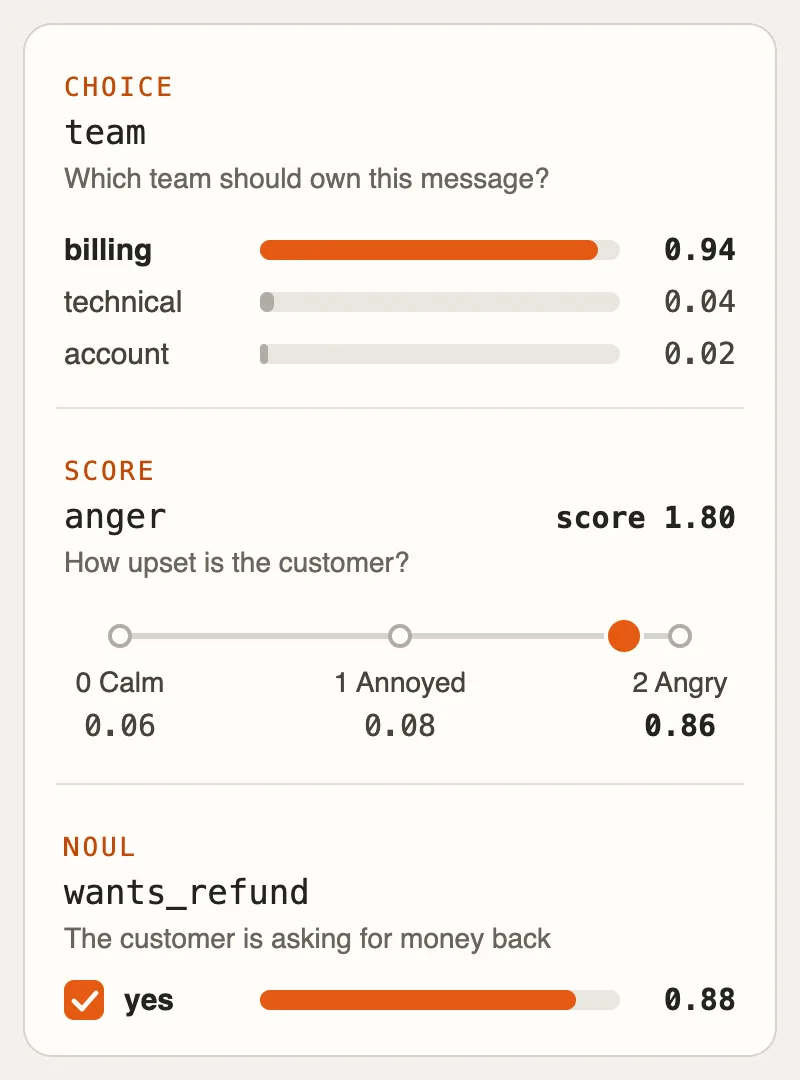
Here is the video's example: a billing complaint arrives in a support queue. The state is the message plus two account fields.
from typesafe_sdk import Choice, Noul, Score, TypeSafeClient

client = TypeSafeClient()  # reads TYPESAFE_API_KEY

ticket = {
    "message": "Second time I've been billed for the annual plan this "
               "month. Fix this today or I'm cancelling.",
    "plan": "annual",
    "charges_last_30_days": 2,
}

TEAMS = {
    "billing": "Charges, refunds, invoices",
    "technical": "Bugs, outages, integration problems",
    "account": "Login, profile, plan changes",
}
MOODS = [
    "Calm and matter-of-fact",
    "Annoyed but polite",
    "Angry or threatening to leave",
]

TEAM_Q = "Which team should own this message?"
ANGER_Q = "How upset is the customer?"
REFUND_Q = "The customer is asking for money back"
Then three questions go in one call:
questions = { "team": Choice( instructions=TEAM_Q, criteria=TEAMS), "anger": Score( instructions=ANGER_Q, criteria=MOODS), "wants_refund": Noul( instructions=REFUND_Q),}result = client.system_one( state=ticket, questions=questions)Choice. Pick one of the listed teams, with a probability for each.
Three questions about one ticket, in one call. The questions are a form: each field says what shape its answer takes.
The instructions and the options are plain English, and that is all the prompting there is. The same code works from JavaScript (@typesafe-ai/sdk) or over plain HTTP, and there are integrations for LangChain and the Vercel AI Gateway.
What comes back? TypeSafe's docs show a real response for a Score question about a bug report: "The export button crashes the settings page in Safari. It works in Chrome, but a few of our customers only use Safari."
{
  "model": "jev-1.13.0",
  "answers": {
    "bug_severity": {
      "type": "score",
      "score": 1.43,
      "confidence": 0.35,
      "legend": {
        "0": "Cosmetic; no impact to functionality",
        "1": "Broken or degraded feature, but workaround exists",
        "2": "Blocking issue; no workaround exists"
      },
      "probabilities": { "0": 0.0, "1": 0.57, "2": 0.43 }
    }
  },
  "usage": { "input_tokens": 332, "output_tokens": 18 }
}
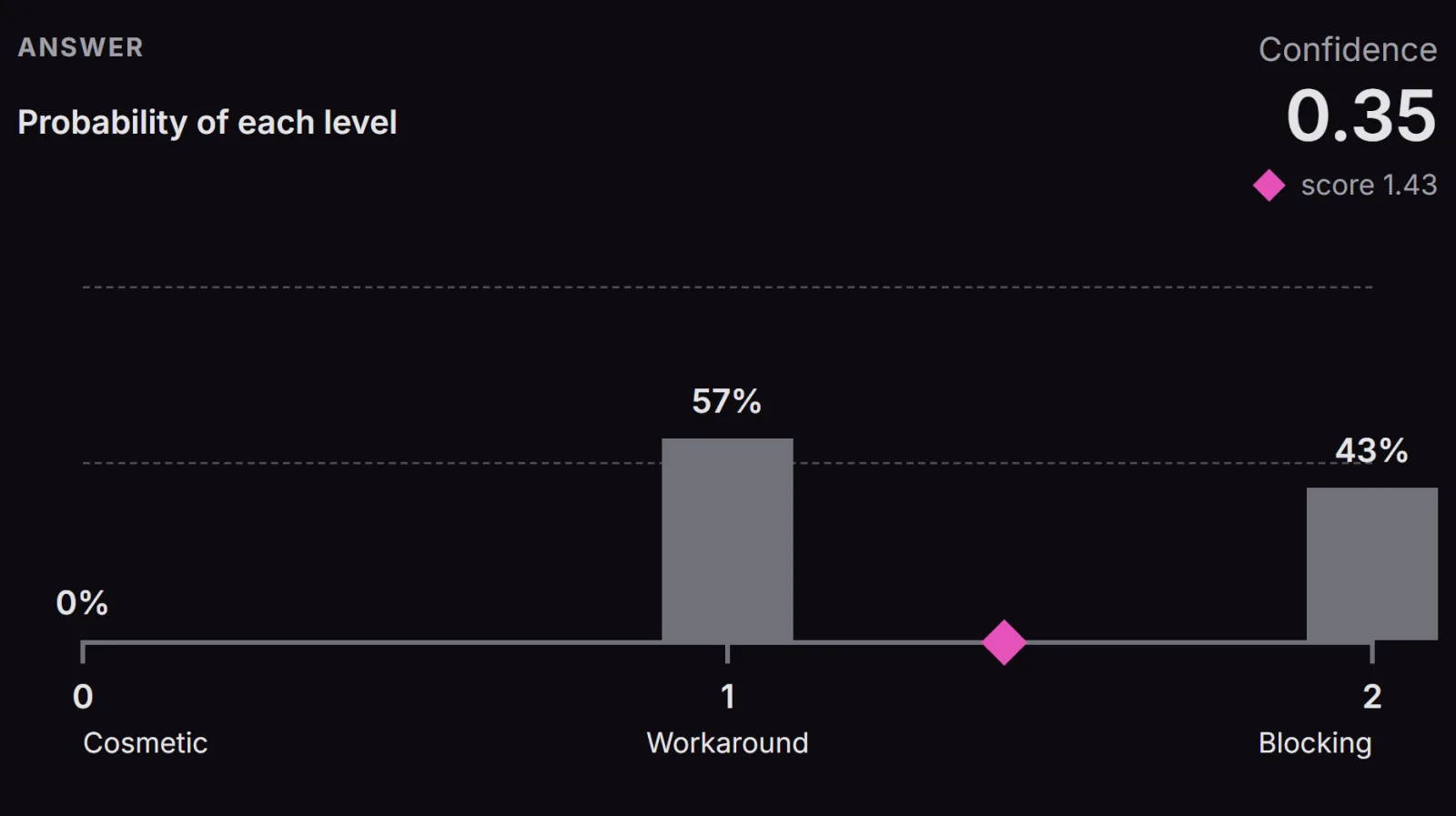
That is a reasonable reading: there is a workaround, but not for everyone. Now look at the confidence. It is not the chance that the answer is right. TypeSafe computes it from how spread out the probabilities are, and here they split 57 to 43 between two levels. That low number is the useful part: it tells your code this answer is close to a coin toss.
Acting on the answers is ordinary code:
team = result.answers["team"]

if team.confidence < 0.5:
    send_to_human(ticket)
elif team.choice == "billing" and result.answers["wants_refund"].noul > 0.8:
    start_refund_review(ticket)
else:
    route(ticket, team.choice)
Start - Jev's answers for a ticket
The routing code above, as the decisions it makes. Every branch is an if-statement on a number, not a parse of prose.
Here is the same decision the old way, then with Jev:
for attempt in range(3): reply = llm.complete(PROMPT + ticket) try: data = json.loads(reply) if data["urgent"] in ("yes", "no"): return data["urgent"] == "yes" except (ValueError, KeyError): continueraise ValueError("no answer after 3 tries")result = client.system_one( state=ticket, questions={"is_urgent": Noul( instructions="The ticket needs a reply today")},)answer = result.answers["is_urgent"]urgent = answer.noul > 0.8An LLM makes the call: wait and pay. Every token of the reply is generated, then billed as output.
The same decision twice. Structured outputs would already remove most of the parsing on the left. What Jev adds is the probability on the right: the number a threshold needs.
Why it's fast: it writes no text
An LLM answers one token at a time, and a reasoning model writes its reasoning first. You wait for every token and pay for it as output. Jev skips generation. TypeSafe says it reads the state once, scores every question against it in parallel, and outputs probabilities over the options you listed.
Jev one pass- reads the state once and scores every question togetherLLM reasoning tokens- a reasoning model writes these firstLLM answer tokens- one token at a time, billed as output
LLM - read
Schematic, not to scale. An LLM writes its answer token by token. Jev reads the state once and scores each question over the options you gave it.
TypeSafe's numbers follow from that design:
Jev's price and response time
For comparison, TypeSafe's launch post puts frontier models at 3 to 329 seconds end to end. With an LLM, output tokens cost about five times as much as input. Jev counts output tokens, 18 in the response above, but does not charge for them: the phishing benchmark's bill matched its input tokens alone. TypeSafe admits it "can't prove it isn't subsidized", and expects prices to "go down, not up".
Asking several questions in one call pays off twice. The questions are scored in parallel, so the call takes about as long as one question. And the state is sent once, so you pay for its input tokens once. TypeSafe's cookbook asks 13 questions about one long article, about 54,000 characters. The article is most of every request:
13 questions about one 54,000-character article
That is about 10 times faster and 12 times cheaper, for the same answers. Most of the saving on the bill comes from sending the long article once, so with a short support ticket as the state it would be much smaller.
TypeSafe also shows Jev playing Doom at about 10 queries a second, for about $7 an hour. It reads the game state as text, not pixels, and TypeSafe notes that "a non-AI doom bot could play better". Treat it as a speed demo, not a skill test.
Calibration, the idea that makes it useful
A weather forecaster is calibrated if it rains on about 70% of the days they say "70% chance of rain".
Ten days forecast at "70% chance of rain"
Show the numbers
| Group | Count of 10 | Share |
|---|---|---|
| Rained | 7 | 70% |
| Stayed dry | 3 | 30% |
TypeSafe trains Jev for that property. Its training method aims for "epistemically honest probabilities". If the probabilities are calibrated, then when Jev picks answers with a probability of 0.8, about 80% of them should be right.
100 answers whose chosen option had probability 0.8
Show the numbers
| Group | Count of 100 | Share |
|---|---|---|
| Right | 80 | 80% |
| Wrong | 20 | 20% |
Calibration is a statement about many answers, never about one. What it gives you is a number you can put a threshold on. Where you set the threshold decides what you automate and what goes to a person.
The confidence field is a different number. TypeSafe computes it from the shape of the probabilities: concentrated means confident, spread out means unsure. It is not the chance of being right: the Safari bug above had a top probability of 0.57 and a confidence of 0.35. What the launch post claims for it is an order: "higher confidence means higher accuracy".
Correction, 24 September 2026: the video goes from this calibration example straight to thresholds on confidence, which can make them sound like one number. They are different numbers: calibration is about the probabilities, and confidence only ranks answers.
Noul answers have no confidence field, since the probability is the answer. For the others, TypeSafe's docs suggest three ranges:
Start - an answer and its confidence
TypeSafe's suggested use of confidence. Where each bar sits depends on the cost of a mistake: showing a balance can act on less certainty than approving a transfer.
The docs add: "Start with conservative thresholds, test with your own data." A confidence of 0.8 does not mean 80% right, so only your own data can show what a threshold buys you.
Update, 24 September 2026: two outside tests now touch calibration, and the larger one is unfavourable. On 2,000 synthetic phishing emails, the phishing benchmark found Jev's probabilities less calibrated than the probability Claude Haiku 4.5 wrote in its reply. The expected calibration error was 0.154 against 0.097, where lower is better. Jev was also worse at ranking phishing above safe email: an AUROC of 0.689 against 0.837, where 1 is perfect.
The smaller test is kinder. On 40 support tickets he wrote and labelled, Paweł Józefiak found accuracy rising with confidence, bucket by bucket. Jev's one routing mistake came with a confidence of 0.33, "the lowest score in the entire run". Neither test is a calibration study.
Jev answers 100 questions, and each time its chosen option has a probability of 0.8. If those probabilities are calibrated, what do you know?
"Can't hallucinate" means the format, not the answer
The launch post says: "While Jev gives up string generation, it's optimized for structured outputs and can't hallucinate." Its charts of structured-output and tool-call error rates show Jev at 0%, and the notes under them explain why:
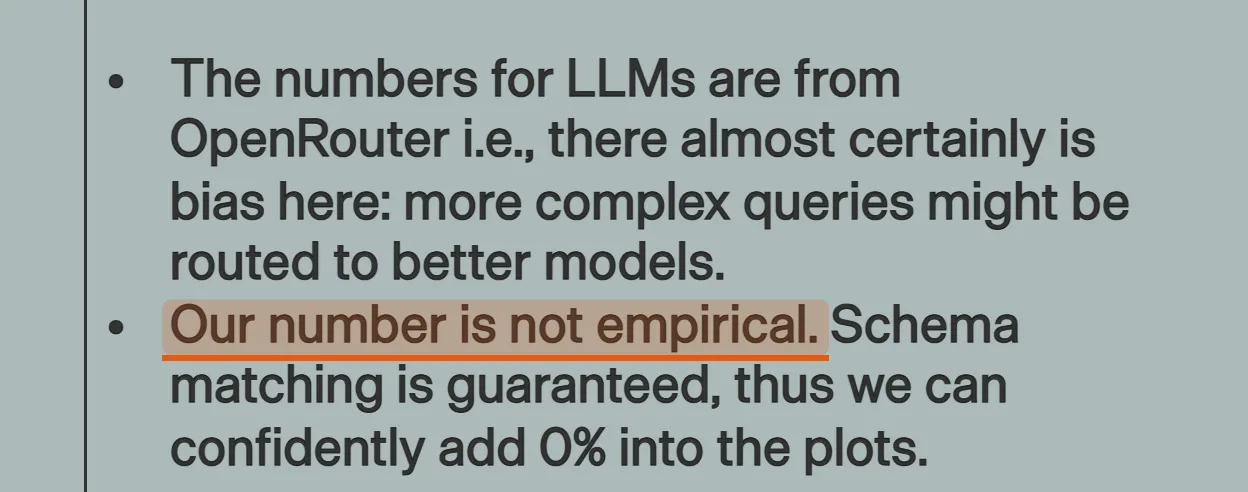
The first note says the LLM numbers came from OpenRouter, which may send harder queries to better models. The second says Jev's 0% was never measured: it is on the chart because the format is guaranteed.
So what is guaranteed is the format. Every answer is one of the options you listed, so Jev can't return broken output. Whether the answer is right is another matter, and a confidence of 1.0 can still be wrong. The format promise still helps, because nothing later in your pipeline breaks on a bad reply. But a wrong answer that is still a valid option gets through, and only testing on your own data shows how often that happens.
| LLM, structured output | Jev | |
|---|---|---|
| format | matches your schema | one of your options |
| right answer | not guaranteed | not guaranteeda confidence of 1.0 can still be wrong |
| how sure | ask it, and it guessesself-reported confidence runs high | a probability per optioncalibration unproven |
| Rule of thumbOnly the format is guaranteed. | ||
format - matches your schema vs one of your options
TypeSafe's benchmarks: mid-pack accuracy, tiny cost
TypeSafe published four workflow evals: security incidents, agent traces, invoice processing and customer service. Each workflow splits a task into narrow questions, with code handling the logic. The LLMs ran through a probability adapter, which TypeSafe says tends to be slower and more expensive.
Read one line of the methods before any chart:
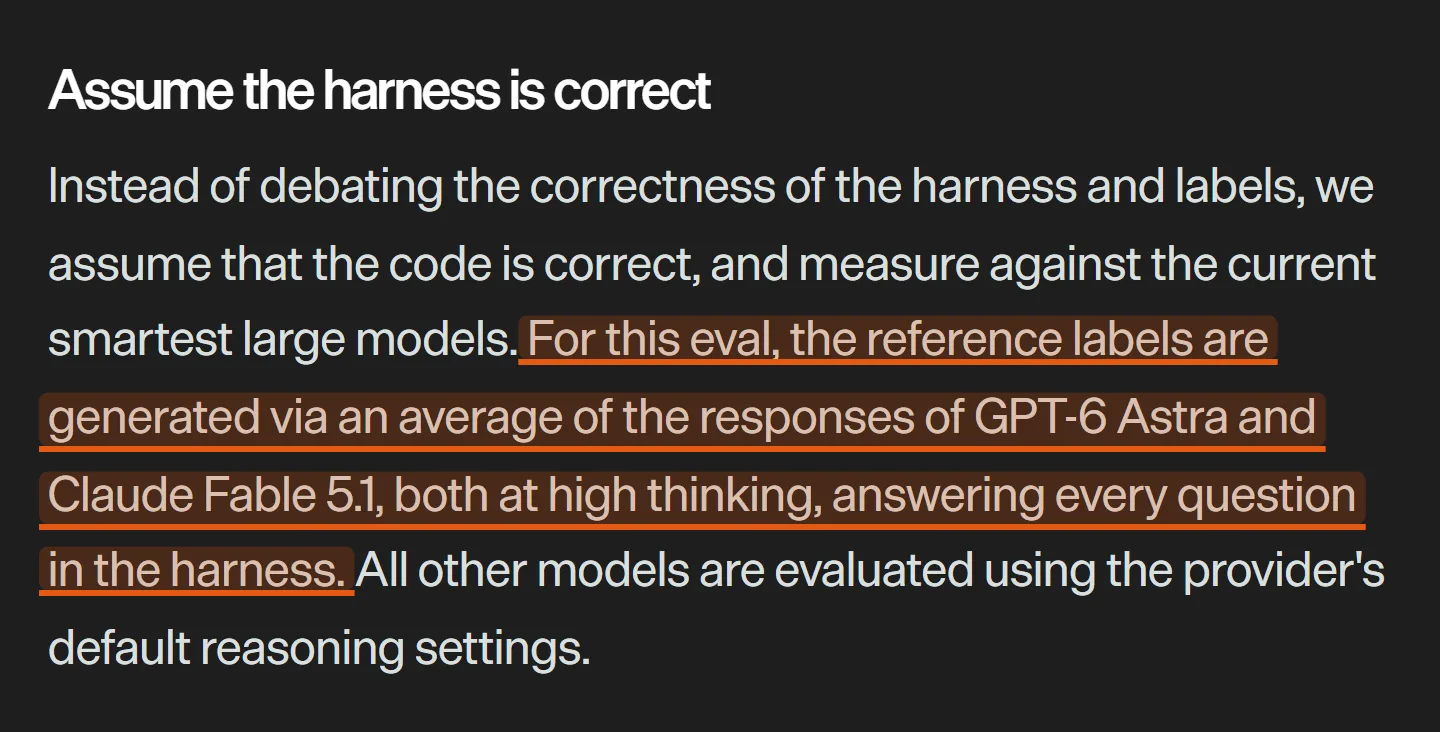
Accuracy here means agreeing with GPT-6 Astra and Claude Fable 5.1, not with people. TypeSafe's own team wrote the workflows and says "some bias could exist". The homepage's "193.6x faster, 444.6x cheaper" comes from this eval, and TypeSafe expects those gains to be "on the higher end" of what you will see.
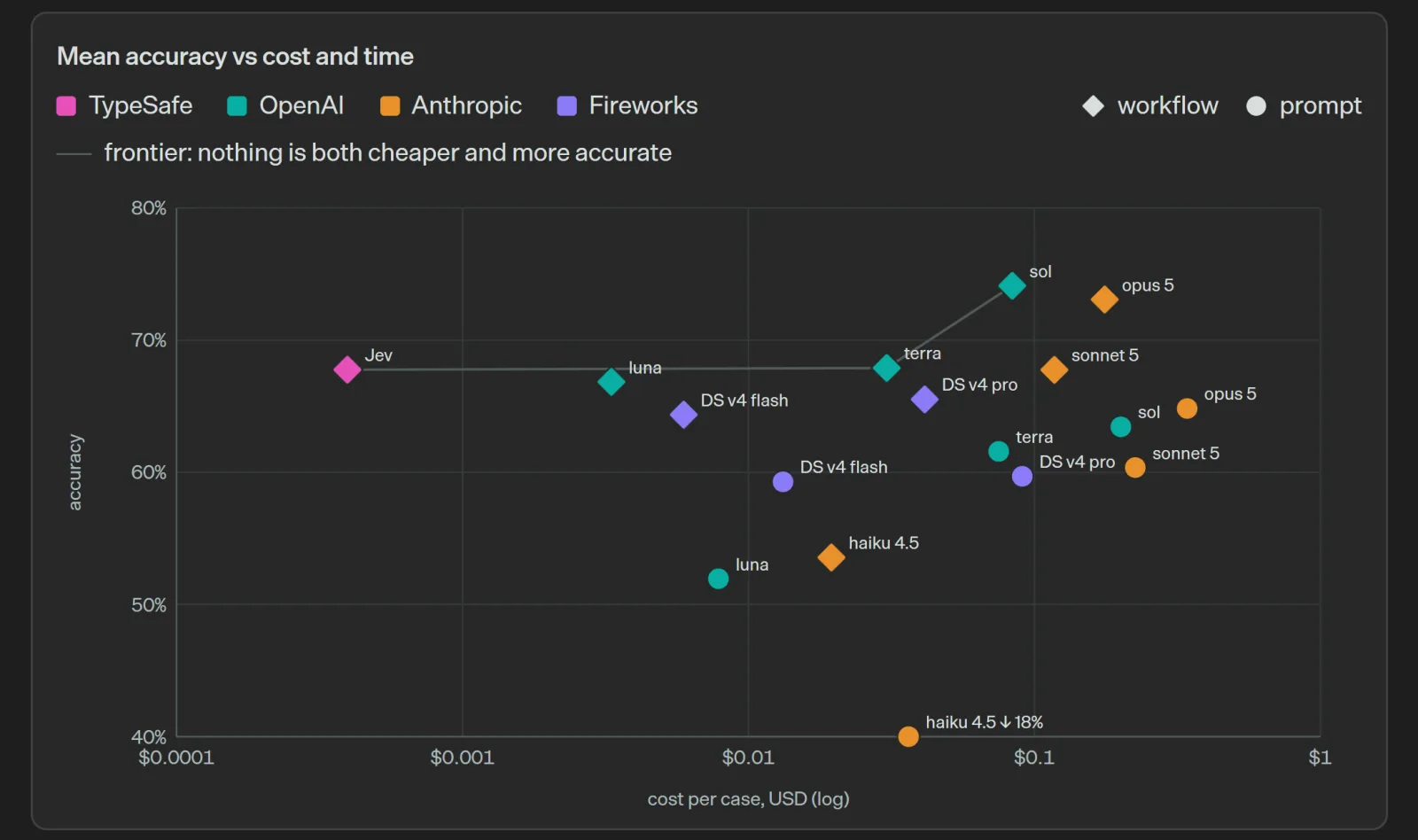
On average Jev scores 67.8%, about the same as GPT-5.6 Terra and Claude Sonnet 5. The two best models, GPT-5.6 Sol and Claude Opus 5, score 74.1% and 73.1%. The gap in cost and time is much larger than the gap in accuracy:
Per case, Jev is roughly 100 times faster than Opus and 400 times cheaper. Against Terra, it is roughly 25 times faster and 75 times cheaper. The eval site rounds Jev's figures, so these ratios are approximate.
The average hides the spread. Here is each workflow:
Jev ranks 3rd of 9 on security incidents and 4th on customer service. On agent traces it ties for 6th. On invoice processing it ranks 8th, at 61.8% against 79.1% for the best model.
TypeSafe does not explain that gap. The workflow already computes sums, dates, account numbers and statuses in code, so the gap is not down to simple arithmetic. It is the largest workflow by far, with eight kinds of documents and seven rounds of questions. Jev's cost per case there is $0.0011, against $0.0001 to $0.0003 in the other three. My guess: large inputs, questions that need several steps of reasoning, and some questions that still ask it to compare rates and prices.
Outside tests: speed holds, accuracy is mixed
Five outside tests are public so far. Every one that measured speed or cost found Jev far ahead on it. Accuracy is mixed.
| Who | Task and size | Accuracy | Speed | Cost |
|---|---|---|---|---|
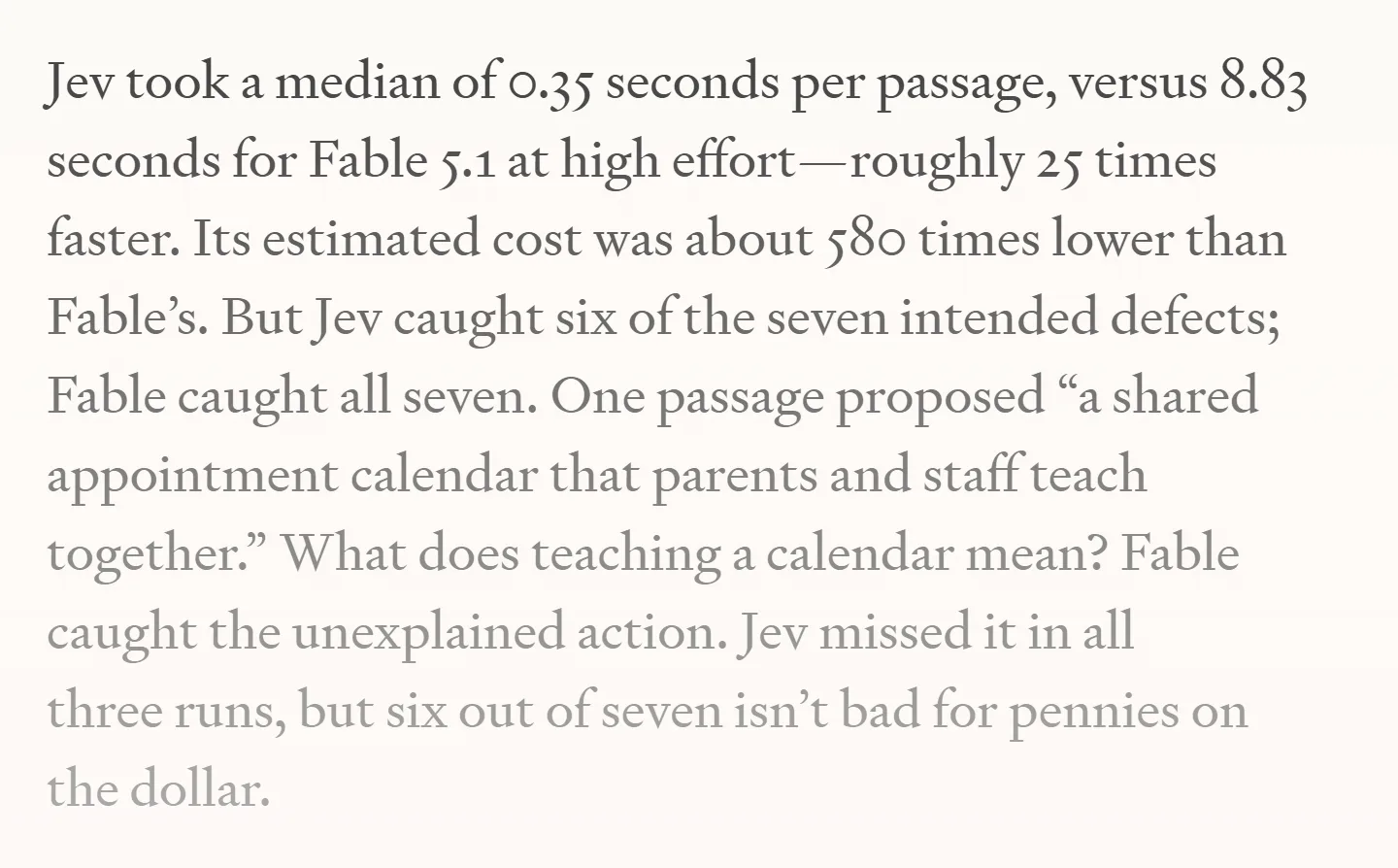
| Mike Taylor, Every | 12 passages, 4 writing checks, 3 runs | Jev caught 6 of 7 planted defects; Claude Fable 5.1 caught all 7 | 0.35 s vs 8.83 s per passage | about 580 times lower |
| Vercel engineer (post on X) | safety classifier, 210 decisions per model | Jev 207 of 210; gpt-5.6-luna 203 of 210 | median 312 ms vs 1,458 ms | not stated |
| Bryo AI (post on X) | 1,565 business emails, 10 categories | Jev 96.4%; two Gemini models 97.5% and 98.5% | not stated | $0.08 vs $0.80 and $1.79 per 1,000 emails |
| Phishing benchmark | 2,000 emails, half phishing, synthetic bodies | asked once: Jev 62.6%, Claude Haiku 4.5 81.3%. Split into five questions: 95.0% and 93.2%, a statistical tie | 239 ms vs 687 ms | $0.038 vs $0.462 per 1,000 emails |
| Paweł Józefiak | 40 support tickets he wrote and labelled | Haiku tied Jev on anger and beat it on routing | 370 ms vs 1.2 s | $0.0000172 per call |
In Mike Taylor's test for Every, Jev was 25 times faster than Claude Fable 5.1 and missed one planted defect that Fable caught. One passage proposed "a shared appointment calendar that parents and staff teach together." What would teaching a calendar mean? Fable flagged it. Jev missed it in all three runs.
The Vercel engineer's post attaches a card with his numbers. Keep in mind that Vercel is a partner: its CEO, Guillermo Rauch, wrote that Jev is "coming to @vercel AI Gateway and likely new default". And it is a post, not a benchmark with published data. Still, the numbers are specific:
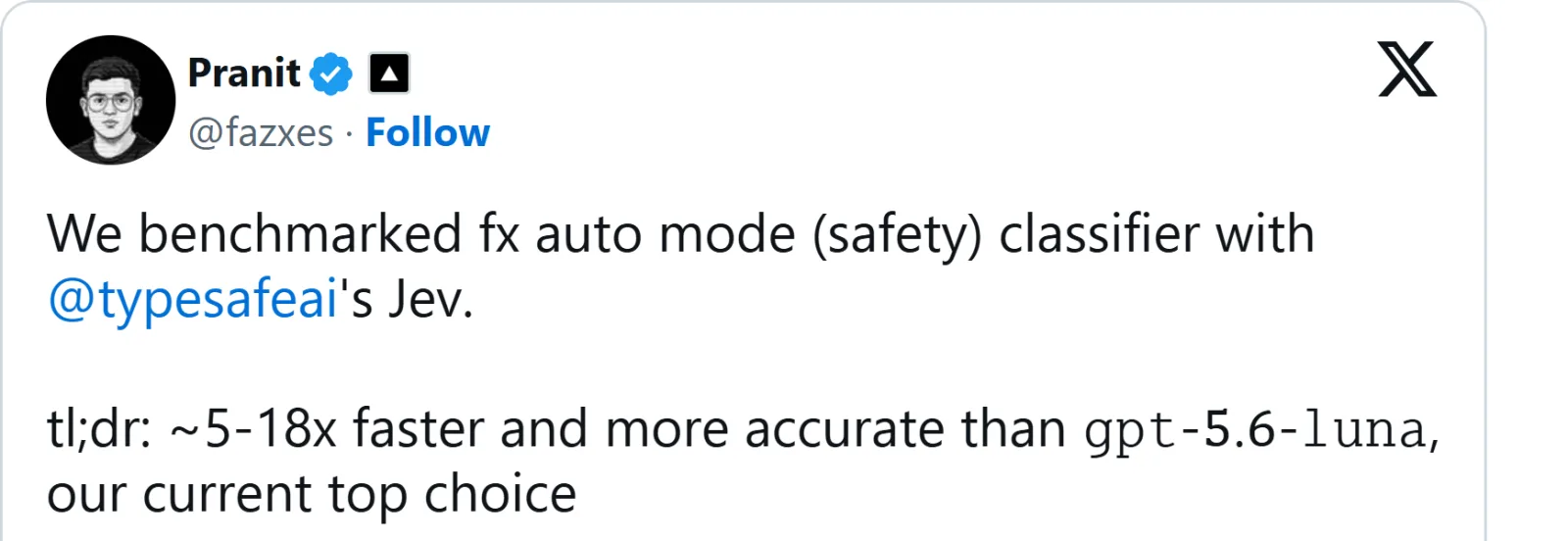
The screenshot above cuts off before his numbers card, so here they are. Jev got 4 more right out of 210, and answered far faster, most of all in the slowest cases:
Correction, 24 September 2026: the video says this benchmark was not published. His post on X does carry his numbers, shown above. It is still a post, not a full write-up with its data.
He also reports that Jev gave the same answer on all 3 runs for every case, while the LLM changed one answer. The phishing benchmark saw more change. When it ran the same 2,000 emails twice, 2.2% of Jev's verdicts flipped. Haiku's flipped 0.7% of the time, on a sample of 300.
Bryo AI's test ran the other way on accuracy, and found something more useful:
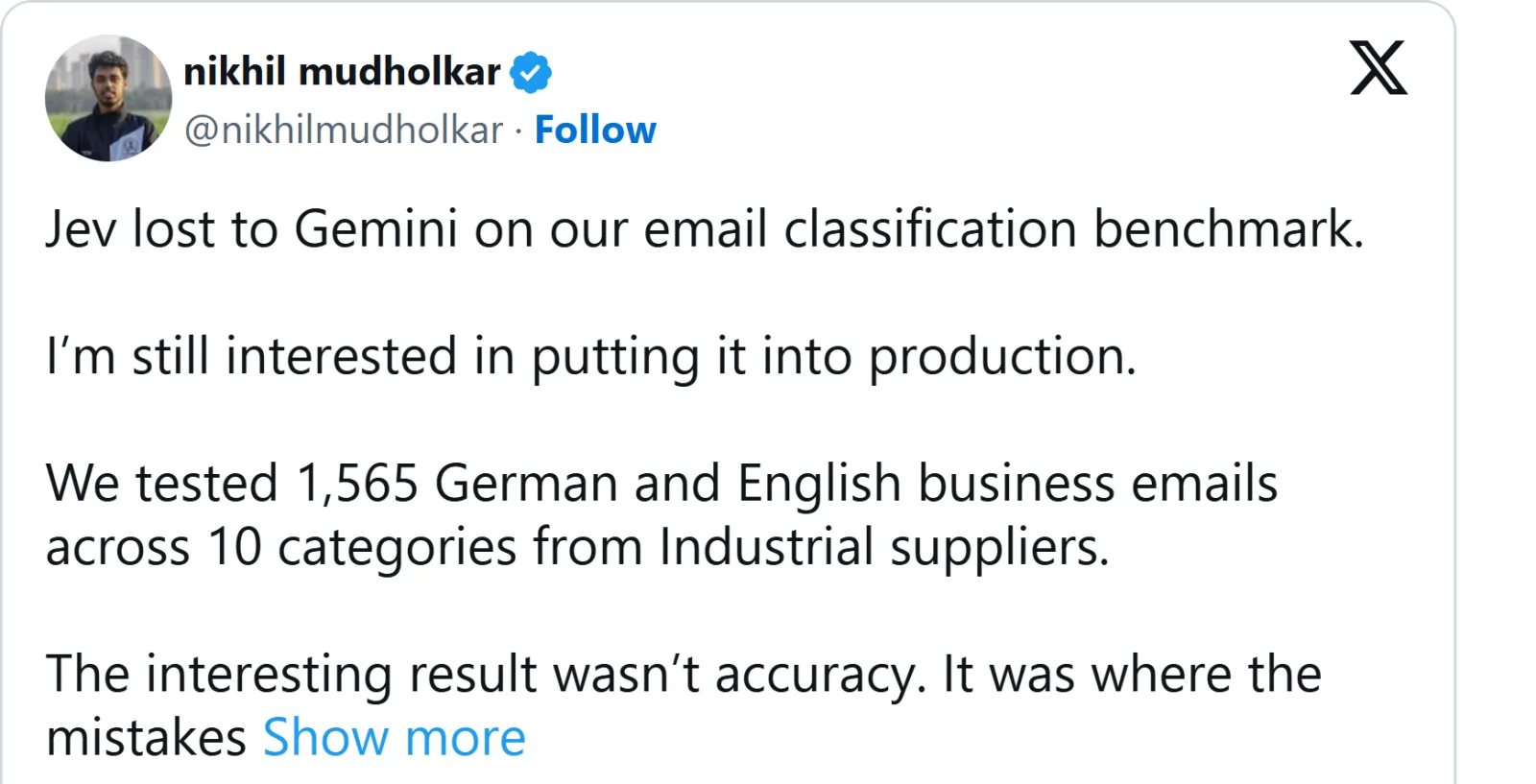
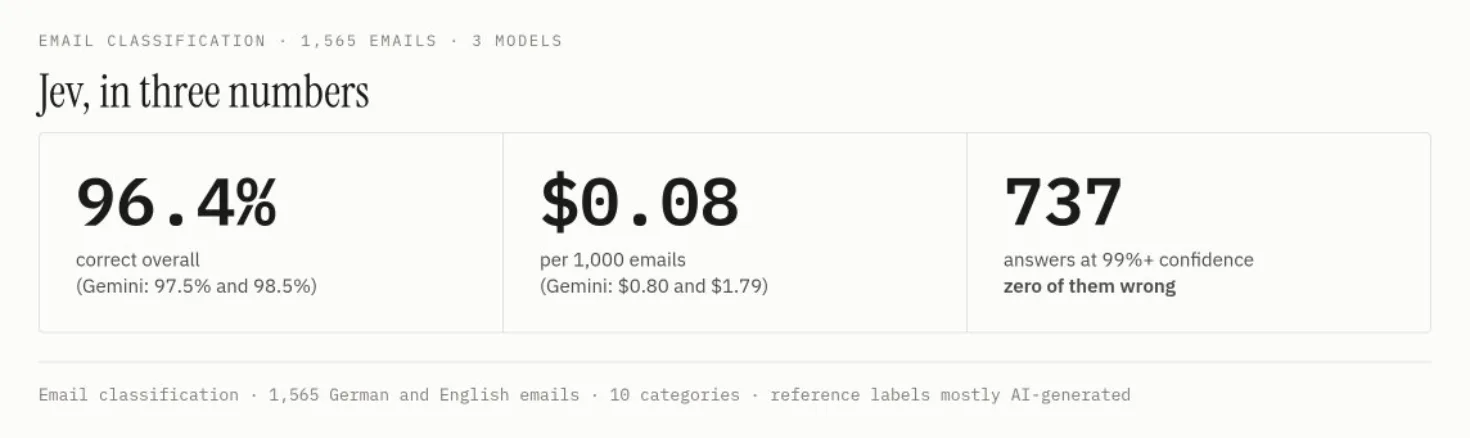
Jev was a little less accurate than two Gemini models, at a tenth of their cost or less. And 737 of its answers came with 99% or higher confidence, none of them wrong. That is the property you would set a threshold on.
The phishing benchmark is the most detailed of the five, and it caught Jev at its worst. When the author simply asked whether each email was phishing, Jev got 62.6% of 2,000 emails right, against 81.3% for Claude Haiku 4.5. The author then asked five narrow questions about warning signs, such as whether the link points to free hosting. A simple statistical model (a logistic regression), trained on half the emails, combined the answers:
On the emails it never saw, the combination of Jev's five answers scored 95.0%. Haiku, asked the same five questions, scored 93.2%, a gap the author finds not significant. And a two-line rule on the link, with no AI at all, scored 91.8%. The author wrote the questions after reading how the dataset was built, and says it "largely separates by construction". In other words, the way the emails were made keeps the two kinds easy to tell apart.
So this test does not show Jev beating an LLM. It shows what TypeSafe's evals show: narrow questions, with code combining the answers, lifted both models. Jev's edge is still the price: by the author's count, its five answers cost about 27 times less than Haiku's and came about 5 times faster.
Splitting the question helps every model
TypeSafe ran each LLM two ways: asked once in a single prompt, and split into a workflow of narrow questions with code doing the logic. Every model scored higher when split, usually by 5 to 15 points:
The gains ran from +5.1 to +14.9 points, and Claude Haiku 4.5 gained +35.5. Not every single run agreed: DeepSeek V4 Flash lost 6.7 points on security incidents, and DeepSeek V4 Pro lost 0.5 on agent traces.
One caution: this is one vendor's eval, and its reference answers came from two frontier models answering the workflow's own narrow questions. That setup favours the split runs. Still, the phishing benchmark found the same pattern independently, for Jev and for Haiku.
You can use this even if you never touch Jev. Narrow questions with the logic in code are easier for any model to get right, and easier for you to test.
Where it breaks, and the habits that help
TypeSafe keeps a page of known failure modes, with a fix for each. There are nine:
| Failure mode | What goes wrong | TypeSafe's fix |
|---|---|---|
| Literal reading | It answers exactly what you asked | State the exact condition in the instructions |
| Math and numbers | Arithmetic and comparisons slip | Keep the arithmetic in code |
| Dates and times | Comparing dates goes wrong | Extract the dates, compare them in code |
| Indirection | Multi-hop logic and double negatives confuse it | Write the instructions as directly as possible |
| Large state | Irrelevant detail drowns the signal | Send only the fields the question needs |
| Adversarial content | Prompt injection in the state | Be explicit in the criteria, and test |
| Contradictions | Instructions and criteria disagree | Treat the criteria as part of the instruction |
| Structural invariants | It may not respect "A implies B" | Don't rely on it; check in code |
| Generation | It cannot produce new text | Turn extraction into a Choice over options |
Three habits help with most of these. First, be literal. Jev answers the question you wrote, not the one you meant:
# Vague: Jev decides what "urgent" means
Noul(instructions="The ticket is urgent")

# Literal: the condition is spelled out
Noul(instructions="The service is down or they are losing money now")
Second, keep math and logic in code. If you already have the numbers, compare and count them yourself:
# Don't ask Jev: "Are more than three line items over $1,000?"
# You have the amounts. Compare and count in code:
over = sum(1 for item in invoice["lines"] if item["amount"] > 1000)
flag = over > 3
Third, ask each thing once. On the same ticket, TypeSafe's docs show "Is the customer asking for a refund?" at 0.72, and the negated question at 0.47:
Two questions that should add up to 1
0.72 + 0.47 = 1.19
TypeSafe's warning: the two "may not be directly comparable". So ask one of them and derive the other:
refund = result.answers["wants_refund"].noul
not_refund = 1 - refund  # never ask the negated question separately
Before you build on it, know the limits (re-checked on 24 September 2026):
| Limit | Value |
|---|---|
| Model | jev-1.13.0; the aliases jev-latest and jev-preview both point to it. Pin the versioned id once your thresholds are set. |
| Request size | 64k tokens per request; 32k for the state plus the longest question |
| Rate limits | 250,000 tokens per second and 1,200 requests per minute, which "can change without notice" |
| Answers | up to 255 options per Choice and 10 levels per Score |
| Language | English works best |
| Access | early access, with a waitlist. Launch week briefly outran capacity, and one outside tester saw "529 system_overloaded" errors. |
| Explanations | none: it does not explain its answers |
Should you try it: test on your own data
Many LLM calls in production are decisions: route this, flag that, is this spam. Those are the ones to try. If a person reads the output, or you can't list every possible answer, keep the LLM.
Start - an LLM call you already make
Could the answer be a form field? Only calls that end in a decision from a list are worth testing.
Where it fits, the design is always the same. Code prepares the data and does any math. Jev answers narrow questions. Your thresholds decide, and only the uncertain cases reach a person or a bigger model.
To find out whether it works for you, test it on data you trust:
- Pick one decision your code already asks an LLM to make.
- Collect a few hundred real examples, and label the right answer yourself.
- Rewrite the call as narrow Jev questions, with any math in code.
- Run both on your examples and compare accuracy.
- Group Jev's answers by probability and check the accuracy in each group.
- Set your thresholds from those groups, then pin the version with
model="jev-1.13.0"so they stay valid.
Step 5 is where calibration either shows up or doesn't. This script does it for Choice and Noul questions. Save a CSV with your label, Jev's answer and the probability Jev gave that answer. For a Choice, that is answer.probabilities[answer.choice]. For a Noul, the answer is yes when noul is 0.5 or more, and its probability is max(noul, 1 - noul).
import csv
from collections import defaultdict

EDGES = [0.0, 0.5, 0.7, 0.8, 0.9, 0.95, 1.0]


def bucket(p):
    for low, high in zip(EDGES, EDGES[1:]):
        if p < high or high == 1.0:
            return f"{low:.2f}-{high:.2f}"


def accuracy_by_probability(path):
    counts = defaultdict(lambda: [0, 0])  # bucket -> [right, total]
    with open(path, newline="") as f:
        for row in csv.DictReader(f):
            b = bucket(float(row["probability"]))
            counts[b][0] += row["jev_answer"] == row["label"]
            counts[b][1] += 1
    for b in sorted(counts):
        right, total = counts[b]
        print(f"{b}  {total:4d} answers  {right / total:6.1%} right")


accuracy_by_probability("results.csv")
If the probabilities are calibrated on your data, each bucket's accuracy falls inside its range: between 80% and 90% right in the 0.80-0.90 bucket. If they are not, set your thresholds from the measured accuracy, not from the probabilities. The same script works on the confidence field, but then expect only a rise from bucket to bucket, not a match. Score answers need a different check, such as comparing the score with your own ratings.
Verdict: the right idea, not yet proven
| Question | What we know | Evidence |
|---|---|---|
| Is it fast and cheap? | Yes | TypeSafe's numbers, and every outside test that measured them |
| Is it accurate? | Mid-pack, and it depends on the task | TypeSafe's evals (graded against two AI models), mixed outside results |
| Are the probabilities calibrated? | Unproven | No published numbers; the largest outside test found them worse than Haiku's |
My take: the premise is right. Many production LLM calls are decisions, and generating text is a slow, expensive way to make them. I'm less sure "System One" lasts as a category, and I would not trust the probabilities until I had measured them. The habits in this post carry over to any model you use.
Sources
Every claim above comes from these, checked on 24 September 2026:
- TypeSafe: launch post, docs, the Choice, Score and Noul pages, confidence, models, pricing and limits, known failure modes, parallel questions cookbook
- TypeSafe's evals: overview, security incidents, agent traces, invoice processing, customer service, LLM probability adapter
- Outside tests: Every, the Vercel engineer's post and Vercel's CEO on it, Bryo AI's post, phishing benchmark, Paweł Józefiak
- Coverage: TechCrunch
- Background: LLMs' stated confidence (Xiong et al., ICLR 2024)